| Standard / Country | Designation |
| EN (Europe) | X2CrNiMo17-12-2 |
| DIN (Germany) | 1.4404 |
| AISI / SAE (USA) | 316L |
| UNS (USA) | S31603 |
| ASTM (USA) | A240 / A276 / A554 Gr. MT316L / A632 |
| BS (UK) | 316S11 |
| JIS (Japan) | SUS 316L |
| AFNOR (France) | Z2CND 17.12 |
| GB (China) | 00Cr17Ni12Mo2 |
| KS (Korea) | STS 316L |
Chemical composition (EN 10088-2, wt%):
| C | Si | Mn | P | S | Cr | Ni | Mo | N |
| ≤ 0.03 | ≤ 1.0 | ≤ 2.0 | ≤ 0.045 | ≤ 0.03 | 16.5–18.5 | 10–13 | 2.0–2.5 | ≤ 0.11 |
X2CrNiMo17-12-2 mechanical properties (annealed, +AT):
| Property | Value |
| Tensile strength Rm | 500–700 MPa |
| Yield strength Rp0.2 | ≥ 200 MPa |
| Elongation A | ≥ 40 % |
| Hardness | ≤ 215 HB |
| Density | 8.0 g/cm³ |
| Process | Temperature | Purpose |
| Solution annealing (+AT) | 1010 – 1150 °C, rapid cool (water quench) | Dissolve carbides, restore full toughness |
| Stress relief | 300 – 425 °C | Remove residual stresses (avoid sensitization range 450–850 °C) |
| Cold working (+C) | Room temperature | Increase strength up to ~1000 MPa |
Corrosion Resistance of X2CrNiMo17-12-2 Stainless Steel
X2CrNiMo17-12-2 (1.4404 / AISI 316L) is a low-carbon austenitic grade with ~2.0–2.5% molybdenum, PREN around 24–26. It delivers superior pitting and crevice corrosion resistance versus 304, performing well in coastal air, fresh water and mild chloride media up to roughly 400 ppm. Its ultra-low carbon (≤0.03%) prevents weld intergranular corrosion, suitable for dilute organic acids and weakly corrosive chemical service, though it is not recommended for concentrated hot chloride or strong reducing acid environments.
Weldability of X2CrNiMo17-12-2 Stainless Steel
X2CrNiMo17-12-2 offers excellent weldability via GTAW, GMAW, SMAW and laser welding. Preheating is normally unnecessary, and post-weld heat treatment is not required thanks to its 0.03% max carbon content, which eliminates sensitization risk. Interpass temperature should stay below 150°C to avoid sigma phase precipitation. Matching 316L consumables are recommended; controlled low ferrite filler helps reduce hot cracking risk for thick sections and pressure vessel fabrication.
Machinability of X2CrNiMo17-12-2
X2CrNiMo17-12-2 has fair machinability, rated approximately 60% of AISI 1212 free-machining steel. Its high ductility and work-hardening tendency easily cause built-up edge during turning and drilling. Operators should adopt lower cutting speeds, positive rake tools, sufficient coolant and steady feed rates. Sulphur-modified variants improve chip breaking, while rigid fixturing is critical to avoid chatter and surface defects for precision CNC parts and polished components.
Applications of X2CrNiMo17-12-2 Stainless Steel
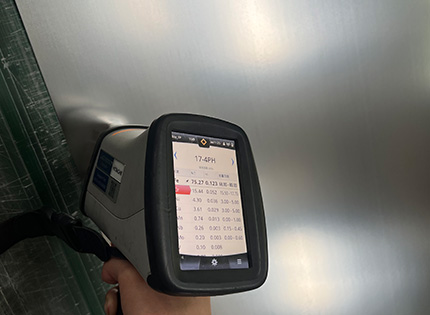
X2CrNiMo17-12-2 (316L) is widely selected for components requiring chloride and acid resistance. Typical uses include chemical process piping, heat exchangers, pressure tanks, pumps and valve trims, food & pharmaceutical production equipment, marine fittings, desalination modules and wastewater treatment hardware. It is also common for sanitary fittings, cryogenic service parts and architectural coastal structures, supplied with EN 10204 3.1 MTC for industrial procurement and third-party PMI inspection.
Which is better, 316L or 904L?
316L (X2CrNiMo17-12-2) and 904L are both austenitic stainless steels, but 904L with ~4–5% Mo and PREN 32–36 delivers far superior resistance to chlorides, phosphoric and sulphuric acid compared to 316L (PREN 24–26). 316L is cost-effective for mild chloride, coastal and general chemical service. 904L is selected for aggressive corrosive media like hot dilute sulphuric acid, pulp & paper and seawater-related processes, while it carries higher material and machining costs. Choose 316L for standard duty and upgrade to 904L when pitting or uniform corrosion risk exceeds 316L’s tolerance.